Pages

Protect Your Computer

Buy McAfee AntiVirus Software

March 21, 2012

ACADEMI tied to Bain Capital?

ACADEMI rising
There is a certain culture that Blackwater has and you can change a couple of the guys at the top of the heap, but they are hiring the same kinds of people, they are doing it in the very same way, they are doing much of the same work – and the leadership comes from the same places with the same connections,” he said, adding that “the failures of the past, which have been dramatic, will continue into the future.”      --Jack Rice, a lawyer and former CIA officer

The above quote came from an RT's (Russia Today) article that appeared December 15, 2011 as the last of the American soldiers were being withdrawn from Iraq. Here's the rest of the article:


The recent name change by the company once known as Blackwater, one of the biggest private security contractors in the US, has led to speculation as to whether the company is returning to Iraq, from where it was expelled after a shooting in 2007.­The company adopted the name Xe Services soon after the shooting incident in Baghdad, which left 17 civilians dead. On Monday it announced another new name, Academi, claiming that the changes represent more than just a change of name.

RT talked to Jack Rice, a lawyer and former CIA officer, who thinks that the company now will certainly try to re-establish itself in Iraq and that it has every chance of succeeding.
They have very deep pockets and they also have very very good connections. You can call this company anything that you like, whether it is Blackwater, whether it is Xe, whether it is Academi, whether it is John Smith, it does not make any difference if there is a lot of money and there are connections, there are opportunities,” Rice said. Commenting on the name change, Rice said that Blackwater/ Academi was unlikely to bring any other changes....
Rice believes, however, that the problem with contractor companies extends further than Blackwater, saying that the main flaw of the system is the lack of a controlling mechanism. According to him the contractor companies have become
independent companies that you hire to do things you don’t want to do” and the real problem “is controlling them and Americans did not do it very well.
Peace activist Puneet Dhaliwal of the group “War on Want” also believes that with American troops withdrawing from Iraq it is quite likely the notorious company will be able to return to the country despite its bloody record and government ban.
“Private military security companies are likely to play an increasingly important role in an unstable Iraq,” says Dhaliwal. “But the problem is not with Academi – formerly known as Blackwater – alone, it is the issue of the whole industry.”
“It is one thing to say there needs to be stability in some sort of area. These companies face a situation when there is no accountability for the way they act,” Dhaliwal told RT. “It is systemic: the whole industry faces no serious restrictions.”
“We have seen a lot of outsourcing in conflicts. That allows moral responsibility to be shifted away onto private companies, where there is simply no such scrutiny as there would be for conventional armies,” added Dhaliwal.

You may recall we reported here that the assets of Blackwater/Xe had been sold in January 2011 to a holding company--USTC Holdings, LLC the major investors in which were private equity firms Forté Capital Advisors (“Forté”) and Manhattan Partners (“Manhattan”). Time will tell whose money these firms were investing in the purchase from Prince and his associates. But, now that all the money has been put together and Academi's team is now in place, the company is ready to take on all those contracts in Iraq (and soon Afghanistan?) that drain the budget of the military and add future budget dollars to medical and pension expenses for veterans.

Instead, the U.S. Government will remain behind the scenes, using contractors and their mercenaries, with almost no accountability or oversight for their actions. Many journalists have attempted to speculate who the buyers really were, but so far not successfully.

Who are they now? 

From reading their website, we note, rather tongue-in-cheek, the new owner obviously hired some expert public relations professionals, if not propaganda specialists, to create their public interface, with an excellent store of positively descriptive adjectives:

ACADEMI’s Board of Directors is responsible for establishing ethical corporate governance and oversight for the company. The board comprises a talented collection of seasoned professionals with vast experience in both the public and private sector. All of the board’s initiatives are guided by ACADEMI’s six core principles of 
  • integrity, 
  • governance, 
  • excellence, 
  • dignity, 
  • growth and 
  • innovation.
You can stop laughing now. Those who are banking on making a profit from handling these mercenary contracts in the future are hoping that Mitt Romney will be occupying the White House this time next year. This writer is betting that most of the millions being funneled into Mitt Romney's superpacs come from these same investors, chomping at the bit to control those mercenary contracts as the wars supposedly end. Here is the evidence:

  • Billy Joe “Red” McCombs, Chairman--founder of the Red McCombs Automotive Group, a co-founder of Clear Channel Communications, a former owner of the San Antonio Spurs, Denver Nuggets and the Minnesota Vikings, and the namesake of the McCombs School of Business at the University of Texas at Austin. He is a long-standing member of Forbes Magazine’s top 400 richest Americans and has owned nearly 400 businesses during his career. ...He is also the co-founder of Clear Channel Communications, Inc. Clear Channel is the largest radio station operator and outdoor advertising business in the world, with operations in more than 30 countries. The company was sold to private investors for an excess of $20 billion in 2008. 
The history of Clear Channel Communications began in 1972 in San Antonio, Texas, with its communications empire supporting Bush family campaigns and ending at the end of those presidential election campaigns by a transfer of stock to Bain Capital, the media empire Mitt Romney claims to have created: 
Clear Channel connection--Hicks, who became vice chairman of the radio behemoth Clear Channel in 2000, helped Bush in whatever way he could. According to Salon, "Hicks announced on a conference call among Clear Channel's senior radio executives that the company was supporting Bush's presidential run, that everyone was encouraged to make donations, and that the legal department would be in contact with donors in order to maintain a proper roster." After 9/11 Clear Channel banned "potentially offensive" songs from its stations, and in the run-up to the war in Iraq, bankrolled supposedly grassroots pro-war "Rallies for America" across the country. The company gave nearly $470,000 to Republican candidates in 2006, roughly the same as in '04. Ironically, Hicks's investment fund sold its stake in Clear Channel in 2006 to the private equity firm Bain Capital Partners--the longtime employer of Mitt Romney. "
Clear Channel's history therefore links ACADEMI's McCombs with the Hicks, Muse friends of George W. Bush and with Mitt Romney's firm, Bain Capital:
    In November 2006, the Company announced that it had entered into a merger agreement with a private equity group co-led By Bain Capital Partners, LLC and Thomas H. Lee Partners, L.P., pursuant to which the group would acquire Clear Channel....On July 30, 2008, the Company announced the completion of a merger with an indirect wholly owned subsidiary of CC Media Holdings, Inc., a corporation formed by a private equity group co-led by Bain Capital Partners, LLC and Thomas H. Lee Partners, L.P.
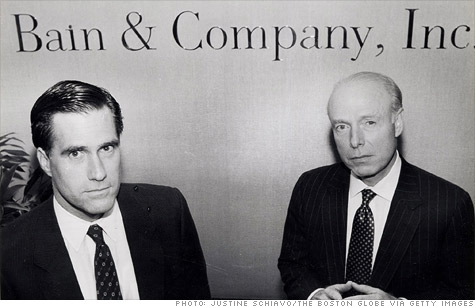
    Mitt's Money
    • John Ashcroft--"As Attorney General, Mr. Ashcroft led the U.S. Department of Justice through the transformational period after the September 11, 2001 attacks, reorganizing the Department to focus on its number one priority: preventing terrorism. The tough antiterrorism campaign he directed helped keep America safe throughout his tenure and resulted in the dismantling of terrorist cells across America and the disruption of over 150 terrorist plots worldwide."
    Only one question here--what did Ashcroft know about 9/11, and when did he know it? And one additional note: There are some very interesting articles linked to Ashcroft's name at his new Texas law firm, Ashcroft Group, including one about his support for Mitt Romney and one about the travails of shedding Blackwater's bad-boy image.
    Charlie Wilson, Joanne Herring
    • Retired Admiral Bobby R. Inman (USN) -- Through all the jobs he's had throughout his career, Inman represents those disenchanted souls who stood with LBJ against President Kennedy in November 1963 and beyond, who were rewarded with positions in the LBJ School in Austin and, like the attorneys who serve on the Board of UTIMCO, managing the university's huge endowments and pension funds. These, mostly, men are also connected to the intelligence staffs that were intriguingly connected to Congressman Charlie Wilson of Lufkin's timber district (Arthur Temple) and to his allegedly romantic links to Houston's social darling Joanne Herring.
    It should also be noted that little has changed between the name changes from Xe to ACADEMI, as shown in the management personnel.

    Oh, and just in case you're looking for a job, there are lots of open positions. And I can assure you, if Mitt is elected, there will be millions more. Money talks.

    January 28, 2012

    Did Newt Make a Deal with a Devil?

    Look out for it to hit the fan soon. And if it doesn't hit it, you'd better duck. If the word does not reach the American public soon about what Newt Gingrich's deal, made by taking money from Sheldon G. Adelson and his wife, Dr. Miriam Adelson (born in Tel Aviv in 1945 as Miriam Farbstein), really means, then it's clear that Republicans voting in primaries leading up to the nomination of their candidate this summer will be missing out on a crucial tidbit of information they desperately need to know. In referring to the support Adelson has given to Gingrich, The Daily Beast recently called Adelson Newt's "sugar daddy."


    Dr. Miriam Adelson is a physician who treats drug addicts with methadone at the Adelson Clinics in Las Vegas and Tel Aviv. The irony is that her husband allegedly cooperates with Asian Triad gangs to bring in revenues to his Venetian resort/casino in Macao--gangs closely tied to the illegal drug trade, according to documentation developed in previous reports from the U.S. Senate Committee on Permanent Investigations.


    The Adelsons at Opening Night of Venetian Casino in Macao
    "Adelson is a whale of a donor, listed by Forbes as the eighth-richest man in America with a net worth of $21.5 billion, and his company controls the Venetian, the Sands, and the Palazzo along the Vegas Strip, as well as three gambling resorts in Macao." 
    Aram Roston in The Daily Beast


    Special Report from Reuters
    March 11, 2011

    BERKELEY, Calif  (Reuters) - When Steve Jacobs joined Las Vegas Sands in 2009, the company was sinking.


    The Sands, which owns the Venetian resort, saw its stock price hit an alarming low, below $2 a share, around the time Jacobs, a 47-year-old Harvard graduate with a boyish face and close-cropped silver hair, took a job heading Sands China, which runs the company's Macau operations.


    But over the course of the next year, Sands mounted a remarkable recovery, thanks in large part to Jacobs' leadership in Macau, a gambling boomtown bigger than Las Vegas and 16 time zones ahead of the Strip.


    "There is no question as to Steve's performance," Sands COO Michael Leven told the company's board of directors in early 2010, according to court records. "The Titanic hit the iceberg. (Jacobs) arrived and not only saved the passengers, he saved the ship."


    The feel-good story, however, was not to last.


    Within months, Jacobs was clashing with the company's CEO Sheldon Adelson over several issues, according to a legal complaint, including whether to hire more so-called junket operators who bring in high rollers. Jacobs says he objected, citing their corrupt reputation -- and last July, the company unexpectedly fired him effective immediately. Two security guards escorted him out of the casino without allowing him to gather his belongings, and then unceremoniously escorted him out of town, Jacobs alleges.
    "Some junket operators have in the past been linked to China's notorious triad criminal gangs and some have murky dealings when it comes to collecting debts from customers. A lack of transparency is common in the industry, with most firms keeping a low profile." --Reuters
    Today, Jacobs is firing on the ship he once saved. The former chief of Macau operations is suing Sands, and his description of unsavory business dealings in the lawsuit has touched off a criminal investigation.


    Earlier this month, the company acknowledged it had received a subpoena for documents pertaining to possible violations of the U.S. Foreign Corrupt Practices Act, which bars U.S. corporations from bribing foreign officials. Not only are the Securities and Exchange Commission and Justice Department looking at Sands' actions, but the FBI has joined in.


    A Reuters investigation in collaboration with the Investigative Reporting Program at U.C. Berkeley has learned that casino executives, U.S. diplomats and the Chinese government share the concerns raised by Jacobs about Macau's booming junkets industry, which they describe as rife with organized crime.


    An extensive review of court records, interviews with high-level federal officials, and State Department cables obtained by WikiLeaks and released to Reuters through a third party, reveal widespread corruption in a region that resembles a Chinese version of the early years of Las Vegas.


    Among the Reuters-IRP investigation's findings:
    • The FBI has joined the federal investigation of Sands, prompted by the Jacobs allegations.
    • Sands has an internal background report on an alleged criminal figure who had financial links to the company.
    • Mainland China restricted visas to Macau based on its distress about the growing power of criminal groups, known as triads, in the region.
    • U.S. casino executives have discussed with U.S. diplomats the pervasive influence of the triads in the junkets for years -- yet nothing has changed.

    Sands says that it has denied all allegations in the Jacobs lawsuit from the outset and on January 21 a subsidiary filed documents seeking to initiate a criminal complaint against Jacobs. It declined to provide a copy of the complaint.


    The SEC and Department of Justice inquiries appeared to be a result of Jacobs' allegations in his wrongful termination lawsuit, Sands said by email to Reuters.


    "Neither the SEC nor the Department of Justice has accused the company of any wrongdoing. The subpoena is described as a fact-finding inquiry and does not mean the SEC has concluded anyone has broken the law," it said.


    BIGGER THAN LAS VEGAS


    Macau, a former Portuguese colony located less than 40 miles west of Hong Kong, for centuries served as a center for trading and piracy in the South China Sea, a base for vice, gold smuggling and espionage.


    But the brazen town on the tip of a Chinese peninsula has evolved into much more than a backwater den of iniquity.


    Today Macau is a super-charged conduit for cash on the lip of the world's fast-growing major economy. The once worn casinos huddled near the ferry docks have gone upscale. And in the last ten years, it has become a major source of cash for America's largest casino operators.


    Since 2001, when China opened its doors to U.S. casinos, annual revenues have increased more than tenfold to reach $23.5 billion today -- more than two and half times the revenues of the Las Vegas Strip and Atlantic City combined. The enclave provides two-thirds of Sands' revenue worldwide, according to securities filings.


    Behind the gaudy numbers, however, public records suggest the region is becoming a growing geopolitical concern.


    The U.S. Department of State, in its 2011 International Narcotics Control Strategy Report, said Macau is "vulnerable to becoming a hub for the laundering of criminal proceeds."


    Beyond the casinos, the report says, the "close proximity border with PRC (China) and Macau's open economy, including lack of controls on cross border physical movement of cash, are factors that create a risk of money laundering and terrorist financing activities."


    And the triads, according to diplomatic cables, are expanding. A trusted academic told diplomats that China had clamped down on Macau visas, "at least in part to stem the rise of organized crime in the mainland."


    The source of this criminal expansion is Macau's unique junket system, which whisks VIPs into casinos, stakes them, and offers legally suspect services to avoid China's strict currency and debt collection laws. The junket companies -- widely linked to the triads, according to diplomatic cables -- generated an incredible 72 percent of the region's gaming revenues last year.
    "Casino operators regret the growing power of 'junket' operators in mainland China that account for most of the Macau casinos' earnings," one U.S. consulate official reported in a cable. "They believe the operators are directly or indirectly involved with organized crime in Macau and the mainland."
    The U.S. casinos operating in Macau are bound by Nevada laws that prohibit them from bringing "disrepute" upon the state. But they have immersed themselves in the junkets -- while privately, according to cables, confiding their concerns about the criminality of the industry to diplomats.


    Another cable quoted a senior U.S. executive saying the growth of the triads was leading to expanding corruption in China. Provincial officials were providing "sweetheart" land sales, business licenses, and government contracts to junket operators, in exchange for bank deposits or cash sums paid to the officials upon arrival in Macau.


    SANDS' COMBATIVE STYLE


    No U.S. casino has more aggressively pursued the Macau dream than Las Vegas Sands.


    Sands was the first U.S. casino to plant roots in Macau in 2004, and has since grown into the largest American company in the region, dwarfing the operations of competitors like Wynn Resorts and MGM Resorts International.


    Sands raised the stakes for the entire territory. From a swath of reclaimed land, it created a new gambling resort called the "Cotai Strip," an Eastern rendition of Las Vegas with plans for shopping, restaurants and fancy hotels. The Chinese government planners wanted a diverse assortment of properties, and Sands has delivered, building the Venetian Arena, the Grand Canal Shoppes and the Four Seasons apartments.


    Sands' Cotai Strip in Macao


    But where Las Vegas rivals went in softly, working with local businesses and regulators, Jacobs' suit and diplomatic cables suggest Sands wasn't there to make friends.


    One diplomat in a cable referred to the casino's "combative" style. Others describe how Sands executives have gone over the heads of Macau politicians to lobby ranking members of China's politburo, much to the chagrin of the locals.


    Jacobs says in court filings that one of his primary tasks involved repairing "strained relationships with local and national government officials in Macau who would no longer meet with Adelson due to his rude and obstreperous behavior."


    Adelson, Jacobs charged, instructed him to secretly investigate senior Macau government officials. "Any negative information could be used to exert 'leverage' in order to thwart government regulations/initiatives," the lawsuit claims.


    Jacobs in his suit also notes that he was repeatedly threatened with termination if he "objected to and/or refused to carry out Adelson's illegal demands."


    In particular, Adelson insisted Jacobs hire a local lawmaker named Leonel Alves, he says in his lawsuit. For more than a year, Alves, a public official in a position to help the corporation, was also listed as its counsel -- a potential conflict of interest central to the U.S. federal bribery investigation.


    A Sands senior executive acknowledged a potential conflict in an interview with the Macau Daily Times last fall. "When we deal with an individual that is a government official, we have to follow the rules of the United States," said Chief Operating Officer Leven. "So we are working our way through that."


    Jacobs, meanwhile, says Adelson was pushing to "aggressively grow the junket business." In his lawsuit, he says that he himself objected to expanding the VIP segment, citing low profit margins and "given recent investigations by Reuters and others alleging (Sands') involvement with Chinese organized crime groups" connected to the industry.


    Now, the FBI has joined the probe into Sands and is exploring the full range of Jacobs' allegations, "getting into all of it," a source familiar with the probe said.


    Leven, the COO, told the Macau Daily Times last week that there were some "mentions" in the federal subpoena about "triads and things like that," adding vaguely, "but we think that's cover."


    SANDS: RETURN OR DESTROY DOCUMENTS


    According to the Jacobs suit, Sands has already done its own poking around within Macau's criminal underworld. The casino commissioned background checks on local officials as well as two alleged criminals.


    Sands has given at least one report to Nevada, a casino regulatory source said, but it has gone out of its way to stop the reports from reaching the public eye.


    Last year, Reuters published a report on a man named Cheung Chi-tai, described in court testimony as the mastermind behind a plot to murder a dealer suspected of cheating.


    At trial a witness identified Cheung as a leader of the Wo Hop To -- one of the largest triads in Hong Kong.


    Cheung was also, according to witness testimony, "the person in charge" of a VIP room at the Sands Macao, and Hong Kong stock exchange filings showed him to be a "substantial shareholder" in a junket company with ties to the cloistered room.


    The allegations emerged in a routine trial, barely noted beyond the crime pages of Hong Kong newspapers. Yet the revelations were historic: this was one of the first documented examples of an alleged criminal figure financially linked to a U.S.-based, publicly traded casino.


    The article led to an ongoing Nevada investigation. The company then commissioned its own private background report on Cheung, said a person involved in the Sands effort who requested anonymity.


    The company also ordered a report, according to documents in the Jacobs case, on another figure who was identified as a member of a triad in a 1992 U.S. Senate Subcommittee probe. Charles Heung was described in a Subcommittee chart of organized crime as an officer of the Sun Yee On triad.


    In a 2007 public hearing, the former chair of the Nevada Gaming Control Board, Randy Sayre, also said he had seen three public documents identifying Heung as "a high-ranking member of the triads," according to a transcript.


    Heung has repeatedly denied any participation in organized crime.


    The Sands background reports on Cheung and Heung are the subject of a series of letters in the Jacobs case. Documents show the former executive still holds copies of at least one of the reports based on the investigations commissioned by the casino.


    Sands' displeasure is reflected in its legal team's demand for the "immediate" return of the internal inquiries.


    "All copies," the attorneys insisted, should "be returned to us or destroyed."


    COMMON KNOWLEDGE


    Nevada spent decades cleansing itself of criminal elements. By the 1980s, as casinos largely assumed corporate control, gambling was widely considered one of the most heavily regulated industries in the United States. Nevada's oversight became the gold standard.


    And from the moment Sands landed in Macau, the industry and state regulators insisted the same rules that apply at home apply there. Casinos can lose their licenses if they consort with the wrong characters.


    Nevada has no office in Macau and largely depends on local oversight, which casinos executives quoted in cables describe as lax.


    Diplomats relay widespread concern about Macau's police and gambling regulator.


    The Macau police force is "afraid of triad groups," a diplomat quoted the academic who was a trusted source as saying. Organized crime leaders in Macau "know the identity of each police force member and where they live," the diplomat continued.


    Macau's Gaming Inspection and Coordination Bureau, which goes by DICJ for its Portuguese acronym, barely enforces its own rules, according to accounts in the cables.


    Sands executives approached diplomats with particular frustration about the agency's oversight. "They alleged that junket operators are routinely licensed after cursory DICJ investigations," a diplomat wrote in a cable, "while the DICJ does not enforce its own reporting requirements."


    A senior executive at MGM told the consulate that "there are some good people at DICJ, but if they're not directed to take enforcement action by Macau's political leadership, they won't."


    One Macau casino executive, quoted in a U.S. State Department cable, reported that 
    "all of the junket operators are directly or indirectly involved with the triads."
    Other cables show U.S. diplomats and casino operators routinely discuss corruption in the Chinese enclave.


    Another diplomat divulged that "private sector leaders have noted many loopholes that enable junket operators -- and the casino concessionaires themselves -- to enter legal gray zones with little fear of investigation."


    Then there is Manuel Joaquim das Neves, the long-standing head of DICJ, who was remarkably candid when discussing the junkets industry with diplomats. During a conversation with a U.S. official about the worldwide economic downturn, he implicitly linked the triads to Macau's gaming sector, saying that "triads' revenues will probably decline in 2009 along with Macau's gaming earnings."


    Neves acknowledged some wiggle room in his agency's licensing, which judges candidates primarily on their criminal history. "If you make hard rules in the beginning, no one applies," a cable quotes him telling U.S. diplomats. "So we forgive small crimes in an applicant's background."


    Neves told Reuters "there's no logic" to any assertion that his agency is falling short of its duties. "The majority accept that we are doing a good job in Macau," he said.


    "I cannot say that in Macau we don't have triads, but things are under control," he added.


    CHINA'S CONCERNS


    The scale of the corruption in Macau has drawn fire from the most powerful and important critic of all -- the mainland China government. And China's ire already has been felt once as the government choked off the supply of gamblers to Macau.


    Criminality within the VIP segment made China "very concerned," one U.S. diplomat revealed in a cable. In late 2008, according to a missive, it changed the rules of the game, cutting the number of visas from mainland China to Macau in a move that was disastrous for U.S. operators, including Sands.


    "The fact that mainland gamblers account for the majority of funds flowing into Macau appears increasingly undesirable to Beijing," says one post. "The perception is widespread that, with the implicit assistance of the big 'junket' operators, some of these mainlanders are betting with embezzled state money or proceeds from official corruption, and substantial portions of these funds are flowing on to organized crimes groups in mainland China, if not Macau itself."


    SO MUCH POWER


    Early last June, at G2E Asia, a conference for casino industry insiders, the Venetian Macao hosted a session to discuss "The Future of VIP."


    On stage, beneath a massive, glittering chandelier, sat three men: a former executive from Sands Macao, an academic, and Sean Monaghan, a junket analyst, who proclaimed: "These guys are huge, they're growing, and they hold so much power."


    Monaghan was articulating what had already begun to be well understood by the U.S. diplomatic corps. By plunging millions of dollars into the development of the VIP sector, casinos had, in essence created a monster.


    Jacobs, quoted in a cable, spoke to this point when he told a diplomat that "the junket operators maintain significant economic and political influence in Macau."


    "The government and all the concessionaires rely heavily on the junket operators for the bulk of their revenue streams," says another cable. "They won't make any big moves against the junkets."


    Another missive points out that as Macau derives over half of its revenues from the VIP market, it has "proven itself either incapable or unwilling" to rein in the companies.


    Toward the end of the session, an emissary from the U.S. consulate rose to make a comment. "I find it remarkable," he said, "that we're talking here about junkets, yet not a single representative from the industry sits before us."


    A murmur circulated through the crowd.


    The gentleman had identified the 800-pound gorilla -- who was not in the room.
    Jacobs had grown wary of the dangers of this gorilla, he said in his complaint. His private objection to expanding the junket business was one of the final battles he fought with his boss [Adelson]. Soon enough, their differences would reach the point of no return.


    Now Jacobs is shouting his concerns for all the world to hear, and federal authorities in Washington DC appear to be paying heed.

    (Additional reporting by Peter Henderson; Editing by Peter Henderson, Lowell Bergman, Jim Impoco and Claudia Parsons)


    January 13, 2012

    Corporation's Bottom Line

    Serious students of covert intelligence do not miss the fact that so much of the contracting through "government" is an old pattern established in the days before American intelligence was institutionalized by agencies such as the Office of Strategic Services and the Central Intelligence Agency. It's always been a tool of big business, big banks and especially those damned international trading groups who owe allegiance to no nation. They serve only the corporation's bottom line.

    Jeremy Scahill 
    September 15, 2010 
    This article appeared in the October 4, 2010 edition of The Nation.

    Over the past several years, entities closely linked to the private security firm Blackwater have provided intelligence, training and security services to U.S. and foreign governments as well as several multinational corporations, including Monsanto, Chevron, the Walt Disney Company, Royal Caribbean Cruise Lines and banking giants Deutsche Bank [whose CEO is Anshu Jain] and Barclays, according to documents obtained by The Nation. Blackwater's work for corporations and government agencies was contracted using two companies owned by Blackwater's owner and founder, Erik Prince:
    1. Total Intelligence Solutions and the 
    2. Terrorism Research Center (TRC).
    Prince is listed as the chairman of both companies in internal company documents, which show how the web of companies functions as a highly coordinated operation. Officials from Total Intelligence, TRC and Blackwater (which now calls itself Xe Services) did not respond to numerous requests for comment for this article.

    One of the most incendiary details in the documents is that Blackwater, through Total Intelligence, sought to become the "intel arm" of Monsanto, offering to provide operatives to infiltrate activist groups organizing against the multinational biotech firm.

    Governmental recipients of intelligence services and counterterrorism training from Prince's companies include the Kingdom of Jordan, the Canadian military and the Netherlands police, as well as several US military bases, including Fort Bragg, home of the elite Joint Special Operations Command (JSOC), and Fort Huachuca, where military interrogators are trained, according to the documents. In addition, Blackwater worked through the companies for the Defense Intelligence Agency, the Defense Threat Reduction Agency and the US European Command.

    On September 3 the New York Times reported that Blackwater had "created a web of more than 30 shell companies or subsidiaries in part to obtain millions of dollars in American government contracts after the security company came under intense criticism for reckless conduct in Iraq." The documents obtained by The Nation reveal previously unreported details of several such companies and open a rare window into the sensitive intelligence and security operations Blackwater performs for a range of powerful corporations and government agencies. The new evidence also sheds light on the key roles of several former top CIA officials who went on to work for Blackwater.

    The coordinator of Blackwater's covert CIA business, former CIA paramilitary officer Enrique "Ric" Prado, set up a global network of foreign operatives, offering their "deniability" as a "big plus" for potential Blackwater customers, according to company documents. The CIA has long used proxy forces to carry out extralegal actions or to shield US government involvement in unsavory operations from scrutiny. In some cases, these "deniable" foreign forces don't even know who they are working for. Prado and Prince built up a network of such foreigners while Blackwater was at the center of the CIA's assassination program, beginning in 2004. They trained special missions units at one of Prince's properties in Virginia with the intent of hunting terrorism suspects globally, often working with foreign operatives. A former senior CIA official said the benefit of using Blackwater's foreign operatives in CIA operations was that "you wouldn't want to have American fingerprints on it."

    While the network was originally established for use in CIA operations, documents show that Prado viewed it as potentially valuable to other government agencies. In an e-mail in October 2007 with the subject line "Possible Opportunity in DEA—Read and Delete," Prado wrote to a Total Intelligence executive with a pitch for the Drug Enforcement Administration. That executive was an eighteen-year DEA veteran with extensive government connections who had recently joined the firm. Prado explained that Blackwater had developed "a rapidly growing, worldwide network of folks that can do everything from surveillance to ground truth to disruption operations." He added, "These are all foreign nationals (except for a few cases where US persons are the conduit but no longer 'play' on the street), so deniability is built in and should be a big plus."

    The executive wrote back and suggested there "may be an interest" in those services. The executive suggested that "one of the best places to start may be the Special Operations Division, (SOD) which is located in Chantilly, VA," telling Prado the name of the special agent in charge. The SOD is a secretive joint command within the Justice Department, run by the DEA. It serves as the command-and-control center for some of the most sensitive counternarcotics and law enforcement operations conducted by federal forces. The executive also told Prado that US attachés in Mexico; Bogotá, Colombia; and Bangkok, Thailand, would potentially be interested in Prado's network. Whether this network was activated, and for what customers, cannot be confirmed. A former Blackwater employee who worked on the company's CIA program declined to comment on Prado's work for the company, citing its classified status.

    In November 2007 officials from Prince's companies developed a pricing structure for security and intelligence services for private companies and wealthy individuals. One official wrote that Prado had the capacity to "develop infrastructures" and "conduct ground-truth and security activities." According to the pricing chart, potential customers could hire Prado and other Blackwater officials to operate in the United States and globally:
    • in Latin America, 
    • North Africa, 
    • francophone countries, 
    • the Middle East, 
    • Europe, 
    • China, 
    • Russia, 
    • Japan, and 
    • Central and Southeast Asia.
    A four-man team headed by Prado for counter-surveillance in the United States cost $33,600 weekly, while "safehouses" could be established for $250,000, plus operational costs. Identical services were offered globally. For $5,000 a day, clients could hire Prado or former senior CIA officials Cofer Black and Robert Richer for "representation" to national "decision-makers." Before joining Blackwater, Black, a twenty-eight-year CIA veteran, ran the agency's counter-terrorism center, while Richer was the agency's deputy director of operations. (Neither Black nor Richer currently works for the company.)

    As Blackwater became embroiled in controversy following the Nisour Square massacre, Prado set up his own company, Constellation Consulting Group (CCG), apparently taking some of Blackwater's covert CIA work with him, though he maintained close ties to his former employer. In an e-mail to a Total Intelligence executive in February 2008, Prado wrote that he "recently had major success in developing capabilities in Mali [Africa] that are of extreme interest to our major sponsor and which will soon launch a substantial effort via my small shop." He requested Total Intelligence's help in analyzing the "North Mali/Niger terrorist problem."

    In October 2009 Blackwater executives faced a crisis when they could not account for their government-issued Secure Telephone Unit, which is used by the CIA, the National Security Agency and other military and intelligence services for secure communications. A flurry of e-mails were sent around as personnel from various Blackwater entities tried to locate the device. One former Blackwater official wrote that because he had left the company it was "not really my problem," while another declared, "I have no 'dog in this fight.'" Eventually, Prado stepped in, e-mailing the Blackwater officials to "pass my number" to the "OGA POC," meaning the Other Government Agency (parlance for CIA) Point of Contact.

    What relationship Prado's CCG has with the CIA is not known. An early version of his company's website boasted that "CCG professionals have already conducted operations on five continents, and have proven their ability to meet the most demanding client needs" and that the company has the "ability to manage highly-classified contracts." CCG, the site said, "is uniquely positioned to deliver services that no other company can, and can deliver results in the most remote areas with little or no outside support." Among the services advertised were "Intelligence and Counter-Intelligence (human and electronic), Unconventional Military Operations, Counterdrug Operations, Aviation Services, Competitive Intelligence, Denied Area Access...and Paramilitary Training."

    The Nation has previously reported on Blackwater's work for the CIA and JSOC in Pakistan. New documents reveal a history of activity relating to Pakistan by Blackwater. Former Pakistani Prime Minister Benazir Bhutto worked with the company when she returned to Pakistan to campaign for the 2008 elections, according to the documents. In October 2007, when media reports emerged that Bhutto had hired "American security," senior Blackwater official Robert Richer wrote to company executives, "We need to watch this carefully from a number of angles. If our name surfaces, the Pakistani press reaction will be very important. How that plays through the Muslim world will also need tracking." Richer wrote that "we should be prepared to [sic] a communique from an affiliate of Al-Qaida if our name surfaces (BW). That will impact the security profile." Clearly a word is missing in the e-mail or there is a typo that leaves unclear what Richer meant when he mentioned the Al Qaeda communiqué. Bhutto was assassinated two months later. Blackwater officials subsequently scheduled a meeting with her family representatives in Washington, in January 2008.

    Through Total Intelligence and the Terrorism Research Center, Blackwater also did business with a range of multinational corporations. According to internal Total Intelligence communications, biotech giant Monsanto—the world's largest supplier of genetically modified seeds—hired the firm in 2008–09. The relationship between the two companies appears to have been solidified in January 2008 when Total Intelligence chair [J.] Cofer Black traveled to Zurich to meet with Kevin Wilson, Monsanto's security manager for global issues.

    After the meeting in Zurich, Black sent an e-mail to other Blackwater executives, including to Prince and Prado at their Blackwater e-mail addresses. Black wrote that Wilson "understands that we can span collection from internet, to reach out, to boots on the ground on legit basis protecting the Monsanto [brand] name.... Ahead of the curve info and insight/heads up is what he is looking for." Black added that Total Intelligence "would develop into acting as intel arm of Monsanto." Black also noted that Monsanto was concerned about animal rights activists and that they discussed how Blackwater "could have our person(s) actually join [activist] group(s) legally." Black wrote that initial payments to Total Intelligence would be paid out of Monsanto's "generous protection budget" but would eventually become a line item in the company's annual budget. He estimated the potential payments to Total Intelligence at between $100,000 and $500,000. According to documents, Monsanto paid Total Intelligence $127,000 in 2008 and $105,000 in 2009.

    Reached by telephone and asked about the meeting with Black in Zurich, Monsanto's Wilson initially said, "I'm not going to discuss it with you." In a subsequent e-mail to The Nation, Wilson confirmed he met Black in Zurich and that Monsanto hired Total Intelligence in 2008 and worked with the company until early 2010. He denied that he and Black discussed infiltrating animal rights groups, stating "there was no such discussion." He claimed that Total Intelligence only provided Monsanto "with reports about the activities of groups or individuals that could pose a risk to company personnel or operations around the world which were developed by monitoring local media reports and other publicly available information. The subject matter ranged from information regarding terrorist incidents in Asia or kidnappings in Central America to scanning the content of activist blogs and websites." Wilson asserted that Black told him Total Intelligence was "a completely separate entity from Blackwater."

    Monsanto was hardly the only powerful corporation to enlist the services of Blackwater's constellation of companies. The Walt Disney Company hired Total Intelligence and TRC to do a "threat assessment" for potential film shoot locations in Morocco, with former CIA officials Black and Richer reaching out to their former Moroccan intel counterparts for information. The job provided a "good chance to impress Disney," one company executive wrote. How impressed Disney was is not clear; in 2009 the company paid Total Intelligence just $24,000.

    Total Intelligence and TRC also provided intelligence assessments on China to Deutsche Bank. "The Chinese technical counterintelligence threat is one of the highest in the world," a TRC analyst wrote, adding, "Many four and five star hotel rooms and restaurants are live-monitored with both audio and video" by Chinese intelligence. He also said that computers, PDAs and other electronic devices left unattended in hotel rooms could be cloned. Cellphones using the Chinese networks, the analyst wrote, could have their microphones remotely activated, meaning they could operate as permanent listening devices. He concluded that Deutsche Bank reps should "bring no electronic equipment into China." Warning of the use of female Chinese agents, the analyst wrote, "If you don't have women coming onto you all the time at home, then you should be suspicious if they start coming onto you when you arrive in China." For these and other services, the bank paid Total Intelligence $70,000 in 2009.

    TRC also did background checks on Libyan and Saudi businessmen for British banking giant Barclays. In February 2008 a TRC executive e-mailed Prado and Richer revealing that Barclays asked TRC and Total Intelligence for background research on the top executives from the Saudi Binladin Group (SBG) and their potential "associations/connections with the Royal family and connections with Osama bin Ladin." In his report, Richer wrote that SBG's chair, Bakr Mohammed bin Laden, "is well and favorably known to both arab and western intelligence service[s]" for cooperating in the hunt for Osama bin Laden. Another SBG executive, Sheikh Saleh bin Laden, is described by Richer as "a very savvy businessman" who is "committed to operating with full transparency to Saudi's security services" and is considered "the most vehement within the extended BL family in terms of criticizing UBL's actions and beliefs."

    In August Blackwater and the State Department reached a $42 million settlement for hundreds of violations of US export control regulations. Among the violations cited was the unauthorized export of technical data to the Canadian military. Meanwhile, Blackwater's dealings with Jordanian officials are the subject of a federal criminal prosecution of five former top Blackwater executives. The Jordanian government paid Total Intelligence more than $1.6 million in 2009.

    Some of the training Blackwater provided to Canadian military forces was in Blackwater/TRC's "Mirror Image" course, where trainees live as a mock Al Qaeda cell in an effort to understand the mindset and culture of insurgents. Company literature describes it as "a classroom and field training program designed to simulate terrorist recruitment, training, techniques and operational tactics." Documents show that in March 2009 Blackwater/TRC spent $6,500 purchasing local tribal clothing in Afghanistan as well as assorted "propaganda materials—posters, Pakistan Urdu maps, etc." for Mirror Image, and another $9,500 on similar materials this past January in Pakistan and Afghanistan.

    According to internal documents, in 2009 alone the Canadian military paid Blackwater more than $1.6 million through TRC. A Canadian military official praised the program in a letter to the center, saying it provided "unique and valid cultural awareness and mission specific deployment training for our soldiers in Afghanistan," adding that it was "a very effective and operationally current training program that is beneficial to our mission."

    This past summer Erik Prince put Blackwater up for sale and moved to Abu Dhabi, United Arab Emirates. But he doesn't seem to be leaving the shadowy world of security and intelligence. He says he moved to Abu Dhabi because of its "great proximity to potential opportunities across the entire Middle East, and great logistics," adding that it has "a friendly business climate, low to no taxes, free trade and no out of control trial lawyers or labor unions. It's pro-business and opportunity." It also has no extradition treaty with the United States.

    October 28, 2011

    The Cancer Weapon

    In a recent but rare series of public appearances in Toronto, Ontario, Canada in October 2011, former science child-prodigy Judyth Vary Baker, was interviewed by a variety of members of Canadian media. The city buzzed with her story of how she became interested in finding a cure for cancer, only to be diverted by an effort to suck her into a medical establishment that allowed itself to be used for political purposes. Rather than finding cancer's cure, her superiors at Tulane Medical School's Ochsner Clinic seemed instead focused on making cancer more deadly in order to create a "bioweapon"--a killer serum that could be used for purposes of assassination.

    Only 19 years old when she arrived two weeks before schedule, Judyth quickly adapted to the unusual circumstances in which she found herself. Events that occurred during the next seven months would be replayed through her mind's photographic memory until the present day. It was that phenomenal ability to recall past conversations and the tidbits of sentimental souvenirs she attempted to save that helped her recapture the scene in the summer of 1963, when she met, worked with, and fell in love with the man called Lee Harvey Oswald. "He hated the name 'Harvey,'" she says, "and refused to use it. He never wrote it unless he was forced to--always calling himself simply 'Lee Oswald' or "Lee H. Oswald'."

    The longest interview she gave was with George Freund, host of Conspiracy Cafe, who, in his introduction of the tapes that appear in two parts on his website stated that the broadcast would
    "explore the use of the cancer weapon in the modern era and wonder if it was used to silence Canada`s other leadership hopeful Jack Layton. We look at the deaths from Roswell Park in various plane crashes. We name names."
     CTV had announced in August that:
    NDP Leader Jack Layton died Monday mere weeks after announcing that he was fighting a new form of cancer, and just months after leading his party to its most successful federal election result ever. Layton was 61 years old. [italics added]
    Prior to Layton's death speculation arose in the press about what type of cancer he was being treated for.
    Layton has been battling prostate cancer for more than a year. Weeks before the writ dropped prompting an election last spring, he underwent surgery for a broken hip. He's been walking with a forearm crutch or cane ever since.
    "My battle against prostate cancer, as it turns out from these tests, is going very well," Layton said Tuesday. The 61-year-old NDP leader said that his PSA levels remain "very, very low." PSA, or prostate-specific antigen, is a protein produced by the prostate gland that increases when cancer is present.
    But Layton said he has a new, "non-prostate cancer" that will require further treatment.
    On the advice of his doctors, "I'm going to focus on treatment and recovery," he said.
    Officials with Princess Margaret Hospital in Toronto, where Layton has been undergoing treatment for prostate cancer since his diagnosis in February 2010, said in a statement that "new tumours were discovered which appear to be unrelated to the original cancer and Mr. Layton is now being treated for this cancer."
    The hospital's suggestion that Layton has more than one tumour is "strange," McMaster's Orovan said, because when cancer spreads, it is often "multi-focal," meaning in different sites.
    Layton said his PSA is nearly undetectable. "If it had been undetectable, as it should be after treatment, that would be one thing," Orovan said. "But he didn't say that, so one wonders if this may in fact be a new manifestation of the same cancer, but not in the prostate."
    The type of cancer Layton died from has apparently never been disclosed, but its appearance in his body after being virtually cured of prostate cancer and seemingly undergoing radiation for it piqued Freund's curiosity, as reflected in the segments below:

    Part 1

     
     Part 2


    We have to wonder about the allegations Judyth has made about the medical establishment and why they would not want her to reveal her connection to both the eminent surgeon Dr. Alton Ochsner and the designated "patsy," Lee Oswald. Are there some secret ties between the banking, medical and political establishment that powerful members do not want revealed?

    The answer would best be presented in a separate post. In the meantime, listen to what Judyth Vary Baker reveals in the videos above.

    September 2, 2011

    Cancer and Man-Made Estrogen (DES)

    Diethylstilbestero or DES

    Beginning in 1949 there was post-war excitement in the agricultural area. Medical researchers had found a promising use for a chemical--called diethylstilbesterol (DES)--they had created in their laboratories. This was a sex hormone that could be implanted in male turkeys to make them fatter and meatier. 

    Something to be even more thankful for as Thanksgiving rolled around?

    Or instead something to increase women's death rate from cervical cancer?

    Perhaps we will never really know because government-funded researchers only tout their presumed successes. They hide the failures under labels marked "TOP SECRET" or "NATIONAL SECURITY".

    DES Used by Farmers to Fatten Turkeys

    Olean Times Herald - Sept. 14, 1949
    Turkey Field Day Planned Near Titusville
    TITUSVILLE, Pa — Turkey growers of northwestern Pennsylvania will have a field day starting at 1:30 p m on Thursday, September 22 at Bob Lowers' Valley View Turkey Farm. Lowers' place is located four miles south of Titusville just off Route B. Turkey growers and scientists have learned to surmount many obstacles. One of their latest is to stimulate turkeys to put on more flesh and fat by a biological chemical process. This is one by injecting two small white pellets under the loose skin of the turkey's head. These pellets are smaller than kernels of wheat and chemically are known as diethylstilbesterol.When Injected into toms 19-21 weeks of age they stimulate the birds to put on more flesh and fat. This fine finish allows early hatched toms to be marketed earlier.

    DES Used To Prevent Miscarriage

    THE GETTYSBURG TIMES, JULY 2, 1988
    By ROBERT C. PARK, M.D., President, 
    The American College of Obstetricians And Gynecologists
    For the past several years, there have been different opinions on how frequently you should have a Pap smear. In January, several national medical organizations formulated one set of guidelines for you and your physician to follow. The American Cancer Society, the National Cancer Institute, the American Medical Association and The American College of Obstetricians and Gynecologist were among the groups that agreed to the new guidelines. Those guidelines state that all women who are 
    • at least 18 years old, or 
    • who are sexually active before age 18, 
    should have a Pap smear once a year. If three consecutive annual smears are negative, and you are not at high risk for any of the conditions that could lead to cervical cancer, then your doctor can decide if you need to continue having the test every year, or if you can have it on a less frequent basis. 

    Many women should continue to have the exam every year, even if three consecutive smears are negative.
    These women are considered to be at high risk for cellular changes on their cervix. They are 
    • women who have had more than one sexual partner, or 
    • whose partner has had more than one partner, 
    • those who were sexually active before age 18, 
    • those with a history of human papillomavirus or other vaginal infections, and 
    • those women whose mothers took diethylstilbesterol (DES) during their pregnancies.
    If a woman is in one of these high-risk groups, an annual Pap test will provide an early warning system to protect her health and her life. If an abnormal condition exists on your cervix, the Pap smear can detect it in the beginning stages when it can be treated and cured. If you are not sure whether you fall into a high-risk category, it is a good idea to continue to have a Pap smear every year.


    DES Used by Men to Prevent Sexual Complications from Mumps
     
    THE OGDEN (UTAH) STANDARD-EXAMINER 
    DECEMBER 5, 1954
    NEW YORK (AP)—Daily doses of a sex hormone, diethylstilbesterol, look promising for preventing sex gland complications in men attacked by mumps, Lts. William T. Hall and Raymond N. F. Killeen, U. S. Naval Hospital here, write in the U.S. Armed Forces Medical Journal. The hormone is given before there are any signs of involvement of the sex glands by the mumps virus. Only nine out of 63 men getting the hormone developed the complication, compared with one-third of 34 men not getting the hormone treatment.


    Human Papillomavirus Linked to Cervical Cancer

    THE DAILY GLOBE, Ironwood, Mi. - Friday, March 2, 1984
    Wart-causing virus linked to cervical cancer 
    DETROIT (AP) — Researchers say they have linked a sexually transmitted virus that causes genital warts to cervical and other cancers. Further studies could could lead scientists to a vaccine for human cancer, a gynecologist at Detroit's Sinai Hospital said Thursday. 

    "The exciting thing about this is that it's likely, before the end of the decade, to build a vaccine for this virus and introduce a program for the prevention of a primary human cancer," said Dr. Richard Reid. The "human papillomavirus" has been linked to cervical and other cancers in studies conducted in Detroit and at the German Cancer Institute in West Germany, Reid said. In samples of vaginal skin, 95 percent of the cancers and 88 percent of  "precancers" showed the virus, compared with only 12 percent in normal specimens, Reid said. The virus causes visible genital warts around the penis or anus of men, but in women, "the lesion can't be seen with the naked eye," he said. 

    In a separate study conducted by German virologist Harald Zurhausen, the DNA in 89 percent of the 55 cancerous specimens tested reacted positively to the virus, indicating that the virus was present, Reid said. "At this time, it's true to say the number of deaths from cervical cancer has been falling," he said. "The death rate in young women is actually increasing rather than decreasing, and the number of people with this virus has also increased. 
    "If not for the pap smear program, we'd have a tragic epidemic of cervical cancer." 

    Other factors contributing to cervical cancer include smoking, herpes infection and a person's immune system!
    Women are at high risk if they were under 20 years old when they had their first sexual experience, had more than three sexual partners or had intercourse with a man who had had multiple partners, according to the American Cancer Society.
    "Another factor that is important is that there are at least five of these viruses that are sexually transmitted," Reid said.

    "For both males and females, this is a persistent virus, and getting this virus often means a lifelong infection," he said. "Or some people are lifelong carriers, and so they can have no awareness, themselves, of the disease and yet infect other people, or ... slowly have a malignancy grow in this area of chronic infection." The virus may also be involved in other squamous cancers, or cancers involving the skin or epidermal cells, said Reid. "It is suspected also in cancers of the mouth, throat, larnyx, and bronchus."